wavelength of 1
Wavenumber

In the physical sciences, the wavenumber (also wave number or repetency[1]) is the spatial frequency of a wave, measured in cycles per unit distance (ordinary wavenumber) or radians per unit distance (angular wavenumber). It is analogous to temporal frequency, which is defined as the number of wave cycles per unit time (ordinary frequency) or radians per unit time (angular frequency).
In multidimensional systems, the wavenumber is the magnitude of the wave vector. The space of wave vectors is called reciprocal space. Wave numbers and wave vectors play an essential role in optics and the physics of wave scattering, such as X-ray diffraction, neutron diffraction, electron diffraction, and elementary particle physics. For quantum mechanical waves, the wavenumber multiplied by the reduced Planck's constant is the canonical momentum.
Wavenumber can be used to specify quantities other than spatial frequency. In optical spectroscopy, it is often used as a unit of temporal frequency assuming a certain speed of light.
Definition[edit]
Wavenumber, as used in spectroscopy and most chemistry fields, is defined as the number of wavelengths per unit distance, typically centimeters (cm−1):

where λ is the wavelength. It is sometimes called the "spectroscopic wavenumber".[1] It equals the spatial frequency. A wavenumber in inverse cm can be converted to a frequency in GHz by multiplying by 29.9792458 (the speed of light in centimeters per nanosecond).[2] An electromagnetic wave at 29.9792458 GHz has a wavelength of 1 cm in free space.
In theoretical physics, a wave number, defined as the number of radians per unit distance, sometimes called "angular wavenumber", is more often used:[3]

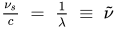
When wavenumber is represented by the symbol ν, a frequency is still being represented, albeit indirectly. As described in the spectroscopy section, this is done through the relationship , where νs is a frequency in hertz. This is done for convenience as frequencies tend to be very large.[4]
Wavenumber has dimensions of reciprocal length, so its SI unit is the reciprocal of meters (m−1). In spectroscopy it is usual to give wavenumbers in cgs unit (i.e., reciprocal centimeters; cm−1); in this context, the wavenumber was formerly called the kayser, after Heinrich Kayser (some older scientific papers used this unit, abbreviated as K, where 1 K = 1 cm−1).[5] The angular wavenumber may be expressed in radians per meter (rad⋅m−1), or as above, since the radian is dimensionless.
For electromagnetic radiation in vacuum, wavenumber is directly proportional to frequency and to photon energy. Because of this, wavenumbers are used as a convenient unit of energy in spectroscopy.
Complex[edit]
A complex-valued wavenumber can be defined for a medium with complex-valued relative permittivity , relative permeability and refraction index n as:[6]


where k0 is the free-space wavenumber, as above. The imaginary part of the wavenumber expresses attenuation per unit distance and is useful in the study of exponentially decaying evanescent fields.
Comments
Post a Comment