Greek: μάθημα, romanized: máthēma Attic Greek: [má.tʰɛː.ma] Koine Greek: [ˈma.θi.ma]

| |||||||||||||||||||||
| |||||||||||||||||||||
|
|
Note the distinctions between this and "n has exactly three prime factors" (A014612) or "n has exactly three distinct prime factors." (A033992). The word "sphenic" also means "shaped like a wedge" [American Heritage Dictionary] as in dentation with "sphenic molars." - Jonathan Vos Post, Sep 11 2005 Also the volume of a sphenic brick. A sphenic brick is a rectangular parallelopiped whose sides are components of a sphenic number, namely whose sides are three distinct primes. Example: The distinct prime triple (3,5,7) produces a 3x5x7 unit brick which has volume 105 cubic units. 3-D analog of 2-D A037074 Product of twin primes, per Cino Hilliard's comment. Compare with 3-D A107768 Golden 3-almost primes = Volumes of bricks (rectangular parallelopipeds) each of whose faces has golden semiprime area. - Jonathan Vos Post, Jan 08 2007 |
Golden 3-almost primes = Volumes of bricks (rectangular parallelopipeds) each of whose faces has golden semiprime area. - Jonathan Vos Post, Jan 08 2007
| |||||
| |||||
|
| ||||||||||||
| ||||||||||||
|
114567-8p90
Animation demonstrating the simplest Pythagorean triple, 32 + 42 = 52.
Greek mathematics

Greek mathematics refers to mathematics texts and ideas stemming from the Archaic through the Hellenistic and Roman periods, mostly extant from the 7th century BC to the 4th century AD, around the shores of the Eastern Mediterranean. Greek mathematicians lived in cities spread over the entire Eastern Mediterranean from Italy to North Africa but were united by Greek culture and the Greek language. The word "mathematics" itself derives from the Ancient Greek: μάθημα, romanized: máthēma Attic Greek: [má.tʰɛː.ma] Koine Greek: [ˈma.θi.ma], meaning "subject of instruction".[1] The study of mathematics for its own sake and the use of generalized mathematical theories and proofs is an important difference between Greek mathematics and those of preceding civilizations.[2][3][4]
Pythagorean theorem
 | |
| Type | Theorem |
|---|---|
| Field | Euclidean geometry |
| Statement | The sum of the areas of the two squares on the legs (a and b) equals the area of the square on the hypotenuse (c). |
| Symbolic statement | |
| Generalizations | |
| Consequences | |

| Geometry |
|---|
 |
| Geometers |
In mathematics, the Pythagorean theorem, or Pythagoras' theorem, is a fundamental relation in Euclidean geometry among the three sides of a right triangle. It states that the area of the square whose side is the hypotenuse (the side opposite the right angle) is equal to the sum of the areas of the squares on the other two sides. This theorem can be written as an equation relating the lengths of the legs a, b and the hypotenuse c, often called the Pythagorean equation:[1]
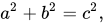
The theorem is named for the Greek philosopher Pythagoras, born around 570 BC. Although it was attributed to him in classical antiquity, there is evidence that aspects of the theorem were known in earlier cultures; modern scholarship has also questioned whether Pythagoras himself was aware of it. The theorem has been proven numerous times by many different methods – possibly the most for any mathematical theorem. The proofs are diverse, including both geometric proofs and algebraic proofs, with some dating back thousands of years.
The theorem can be generalized in various ways: to higher-dimensional spaces, to spaces that are not Euclidean, to objects that are not right triangles, and to objects that are not triangles at all but n-dimensional solids. The Pythagorean theorem has attracted interest outside mathematics as a symbol of mathematical abstruseness, mystique, or intellectual power; popular references in literature, plays, musicals, songs, stamps, and cartoons abound.
Comments
Post a Comment