Alpha Acceler Space the new frontier on the black background
Circus/Velociraptor={{{3.14159ΣπΨ}}}
Αψψελερατιον/Ωελοψιτυ =
Ν Χ {{3.14159ΣπΨ}}{{3.14159ΣπΨ}}{{3.14159ΣπΨ}}
Weight = {{3.14159ΣπΨ}}{{3.14159ΣπΨ}}N
Gravatitational Con
stand
Strong nuclear force
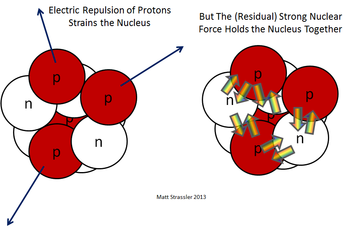

The strong nuclear force is one of four fundamental forces in nature. The strong force is 'felt' between nucleons (protons and neutrons) inside of the nucleus of an atom. The strong nuclear force is sometimes referred to as just the strong force or the strong interaction.[2]
This force is strong enough that it overcomes the repulsive force between the two positively charged protons, allowing protons and neutrons to stick together in an unimaginably small space. The strong force dies off with distance much faster than gravity or the electromagnetic force, so fast that it's almost impossible to detect the strong force outside of a nucleus. (The strong force and the weak force are not inverse square laws.)
The nucleus (and the distance over which the strong force acts) is incredibly small (please see size of the universe for some online demonstrations to show this scale). Despite these small sizes, they still produce a great deal of energy. As is discussed on the work page, the stronger the force (or the greater the distance), the more energy is transferred for an interaction. The strong force stores an incredibly large amount of energy in nuclei compared to the electromagnetic force, which is what governs chemical reactions. This is why nuclear fuel has ~1 million times the density of any chemical-based fuel (coal, natural gas, oil); see energy density for graphics displaying this difference. The big challenge is that very careful engineering is required to access the energy stored from the strong force.
A full treatment of the strong force requires many years of intensive study. To learn more about the strong force please see the hyperphysics article on the strong force. Additionally, there is a comprehensive (although longer) article on what holds nuclei together by Prof. Matt Strassler.
Below is the Scishow's series on fundamental forces part 1a (strong force inside of nucleons) and 1b (between nucleons):
Weak nuclear force
The weak nuclear force (or just the weak force, or weak interaction) acts inside of individual nucleons, which means that it is even shorter ranged than the strong force. It is the force that allows protons to turn into neutrons and vice versa through beta decay. This keeps the right balance of protons and neutrons in a nucleus. The weak force is very important in the nuclear fusion that happens in the sun.[1] Nuclear fusion has also been created in laboratories, and that process requires the weak force to work too. See size of the universe for a list of visuals demonstrating how short ranged the weak force is.
As the name implies, the weak force is much weaker than the strong force, or the electromagnetic force, but it is quite a bit stronger than the gravitational force.
Modern physics has unified the electromagnetic and weak forces into the electroweak force. There is a continued effort to try to unify all of the forces in a grand unified theory.
Fully understanding the weak force takes many years of study, but some fun places to start include hyperphysics or the blog of Prof. Matt Strassler.
Below is the Scishow's series on fundamental forces part 2, the weak force:
Lorentz Force
The Lorentz Force is the force on a charged particle due to electric and magnetic fields. A charged particle in an electric field will always feel a force due to this field, of magnitude . A charged particle in a magnetic field will only feel a force due to the magnetic field if it is moving with a component of its velocity perpendicular to the field. If it moves parallel to the magnetic field, it experiences no force. These two forces are often studied separately, but the sum of these two forces creates a force that we call the Lorentz force.

Figure 1: A particle with charge travelling with velocity in a magnetic field .
A charged particle moving through a magnetic field of strength with a speed will feel a Lorentz force (Figure 1) with a magnitude of:
where is the angle between the velocity of the particle and the magnetic field (field lines run from N to S) and is the charge of the particle. This force acts at right angles to both the magnetic field and the velocity of the particle. Fleming's left-hand rule (where the thumb represents force, the first finger the magnetic field, and the second finger the velocity if the particle is positively charged) can be used to remember the direction of this force. In terms of co-ordinates, if velocity is aligned with the axis and the field aligned with , then the force is in the direction.
A current-carrying wire in a magnetic field will feel a Lorentz force in a direction given by Fleming's left hand rule, with a magnitude of:
where is the length of the wire in the magnetic field, is the current flowing through the wire and is the angle between the wire and the magnetic field.
When a charged particle moves through a magnetic field, it experiences a Lorentz Force, providing it is not moving parallel to the field. This force acts at right angles to both the velocity of the particle and the magnetic field .
The direction of this force in various situations is shown in Figure 2—it depends on the direction of the velocity of the particle and the magnetic field as well as the sign of the charge of the particle. The two ways of remembering the direction of this force given below. Both are variants of the "left hand rule", as they use the fingers on a left hand to define directions.
Thumb, First finger and Second fingers:
These are held at right angles to each other and rotated so that:
- the First finger points in the direction of the magnetic Field
- the Second finger points in the direction of the Current (remembering that the current due to an negatively charged particle is in the opposite direction to its velocity)
- the direction that the Thumb now points in is the direction that the Motion would tend to if the magnetic force were the only force present.
FBI:
An alternative way of remembering the left hand rule is by using the acronym "FBI" to label your fingers. "F" refers to your thumb, "B" to your first finger and "I" to your middle finger.
Holding these three fingers at right angles to each other gives the relation between the directions of the force , magnetic field and current .
The above can be generalised to a velocity or current at angle to the magnetic field by separating the first and second fingers by an arbitrary acute angle.
Another useful way of working out this direction is to write the Lorentz force using vector notation, as described later on. This is useful because this form of notation, using the vector cross product, appears in many different branches of physics, and so being able to use it is more useful than memorising a rule that only refers to one specific situation.

Figure 2: Direction of the Lorentz force in several different situations
Figure 2: Direction of the Lorentz force in several different situations
The magnitude of the Lorentz Force is given by:
where is the angle between the velocity of the particle and the magnetic field, and is the charge of the particle.
If the particle is moving in the direction of the magnetic field, not cutting across any field lines, and there is no Lorentz force acting on the particle.
If the particle is moving perpendicular to the magnetic field, and the particle will undergo circular motion with a radius . The Lorentz force provides the centripetal acceleration:
The Lorentz force on particles with positive charge and those with negative charge acts in opposite directions, causing their paths to curve in opposite directions. This is how positrons (the anti-particle partner of electrons) were identified in cloud chambers.
6.28318=
{{3.14159ΣπΨ}}+{{3.14159ΣπΨ}}
The Alpha to
eat on {{{3.14159}}} eight
Alpha/Volume of velocity
velocity is the city where the v e lo
the con sum pt ion required to move said
CON where Σum is
mass defined as the meeting place
from the way that can not be named as zaza and so is
f(x) where
F(x)= X(f)
with certain certainty
water works to wonder the meat in to meant
the mass of
one cubic inch of
one cubic wet ness
is (3.14159)X(3.14159)
measured in certainly certain units of certainty ness
as applied when the blue ball of ballness is balling along the
3.14159 defined line of bananna
ness at a spread of 24 every 1/24000 of an ice cube
on a hot tin roof in Tuskaloosa where with certain certainty
the tusk are loosa
Comments
Post a Comment